Two Ways to Build a Perfume: A Single Plant vs a Split Supply Chain
There is only one perfume manufacturing process — compound, macerate, filter, fill, crimp, test and pack — but there are two ways to run it: inside one plant, or across a chain of specialist vendors coordinated by the brand. The chemistry does not change between the two routes; the risk profile does. A single plant concentrates accountability and limits flexibility, while a split chain spreads cost and multiplies the handovers where a project can stall.
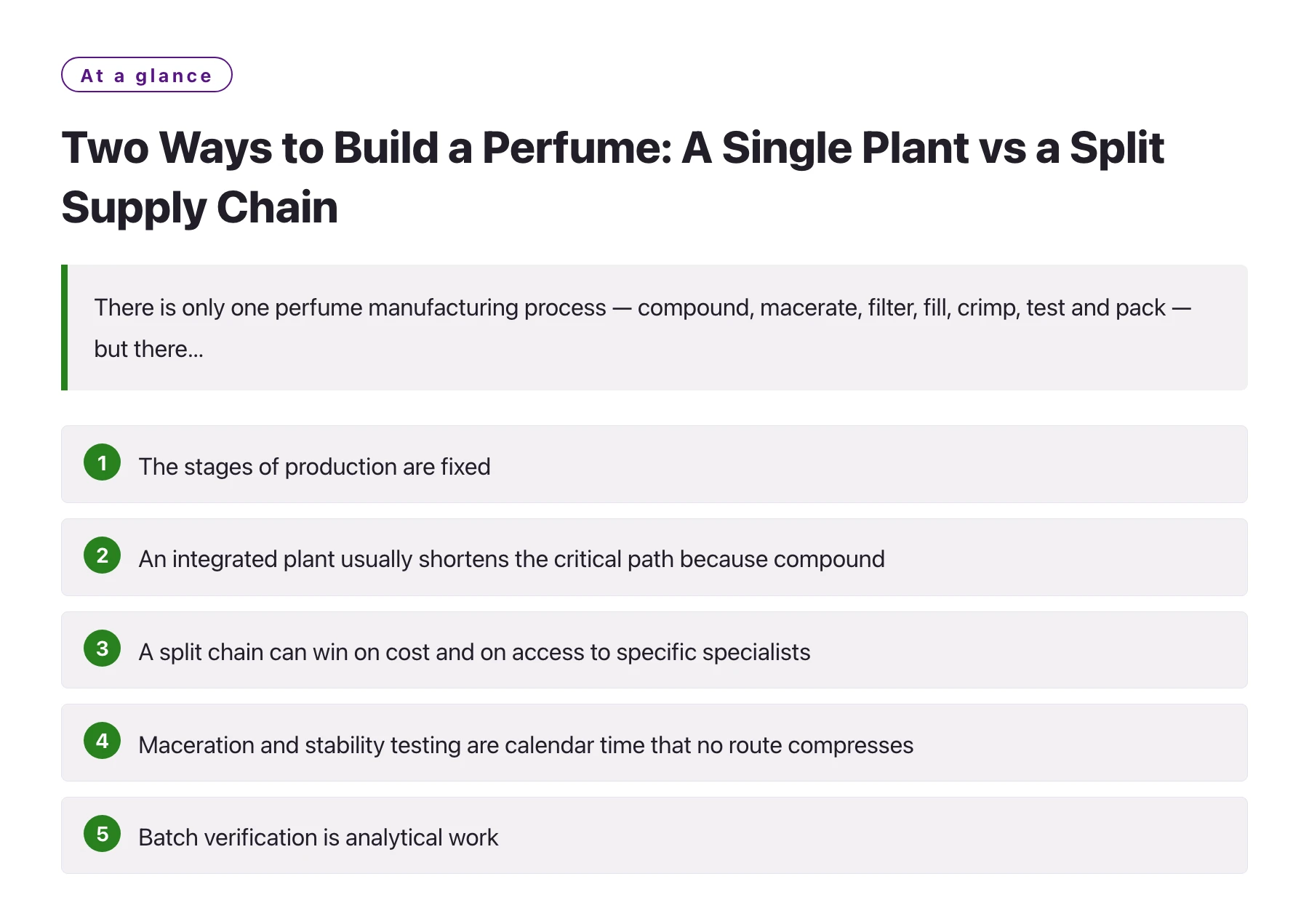
Key takeawaysThe stages of production are fixed, but each stage is a handover, and every handover is a place where a specification can drift. · An integrated plant usually shortens the critical path because compound, fill and pack happen on one site with one set of records. · A split chain can win on cost and on access to specific specialists, at the price of the brand becoming the coordinator of its own project. · Maceration and stability testing are calendar time that no route compresses; they run in parallel with packaging work or they delay the launch. · Batch verification is analytical work, and a chemistry laboratory's methods are what turn a visual check into a measurement [1].
Buyers often assume that the choice is between a big factory and a small one. The more useful distinction is between a supplier that owns the whole process and a supply chain assembled from parts. Both are common, both work, and each fails in a different way.
What follows compares the two routes stage by stage, using the sequence that any fragrance product follows regardless of who performs it. The comparison is deliberately unflattering to both, because the right answer depends on the buyer's own capability rather than on a general rule.
Route A: the integrated plant
In an integrated route, a single manufacturer takes the brief from formula development through compounding, maceration, filling, crimping and packing, and usually handles decoration on site as well. The brand receives one quotation, one lead time and one counterparty.
The strength of this route is accountability. If the fragrance performs differently after filling, there is no argument about whether the concentrate or the filling line is responsible, because one organisation owns both. Records stay in one file, which matters more than buyers expect until the first time an importer asks a question about a batch that shipped nine months ago.
The weakness is flexibility. An integrated plant will normally be efficient within the formats and pack sizes it already runs, and less efficient outside them. A brand that needs unusual decoration, an uncommon closure or a very small first run may find the integrated route slower and more expensive than assembling the same process elsewhere.
Where the integrated route earns its margin
Most of the benefit is not in the unit price, it is in the schedule. Because compounding and filling sit in the same building, a change in batch timing does not require a shipment to be redirected or a vendor to be rebooked. On a launch with a fixed retail date, that resilience is often worth more than a few cents per unit.
Route B: the split chain
In a split route the brand or a coordinating agent buys each stage separately: a development house for the concentrate, a filler for the liquid, a glassworks for the bottle, a decorator, a printer for the carton. This is common for brands with high volume, unusual packaging requirements, or an existing supplier relationship in one part of the chain.
The economics can be better, particularly at volume, and specialist vendors can be genuinely better at their one stage. Fine fragrance work in particular tends to concentrate specific skills — heavy glass finishing, precise crimping, complex decoration — in different places, which is why fine fragrance manufacturing is often assembled rather than bought whole.
The cost is coordination. Every handover needs a specification, a tolerance, a delivery window and a named person on both sides. The brand is no longer a customer of a process; it is the owner of one. Projects fail at handovers, and a split chain has four or five of them instead of none.
The hidden job the brand takes on
When a brand splits the chain, it inherits the work that an integrated manufacturer performs invisibly: checking that a bottle arriving from the glassworks actually matches the pump that will be crimped onto it, and that the carton dimensions still close around both. Component compatibility is not a formality — it is a testable property, and third-party laboratories list it among standard cosmetic and personal care testing services precisely because mismatches are common [2].
This is not an argument against splitting. It is an argument for being honest about whether the brand has the staff, the time and the supplier relationships to run the coordination, because a split chain managed badly is more expensive than an integrated one managed well.
Most of why a sample and the bulk order can differ traces back to this handover: a change that is invisible at a hundred units can be decisive at ten thousand.
The same process, two ways
| Stage | Integrated plant | Split chain | Where it usually goes wrong |
|---|---|---|---|
| Formula development | In house, from the supplier's own library | A development house, then transferred | A formula transferred without a reproducible bill of materials |
| Compounding | Same site as filling | Often at the development house | Batch size change alters the profile and nobody re-checked it |
| Maceration and resting | Scheduled by the plant | Scheduled by whoever holds the tank | Tank time is not reserved, so the resting period slips |
| Filling and crimping | On the same line as the pack | A separate filler | Crimp settings differ from the approved sample |
| Decoration | Usually in house or alongside | A dedicated decorator | Artwork approved on screen, not on the actual surface |
| Packaging assembly | Carton and shipper on site | Printer and converter, separate | Component tolerances stack up and the carton will not close |
| Batch verification | Internal laboratory, plus third party | Third-party laboratory | No retained reference sample, so no basis for comparison |
| Change handling | One counterparty | Four or five counterparties | Nobody owns the fix, so the schedule absorbs it |
Run a finger down the last column. The failures are almost identical in both routes — the difference is how quickly they are found.
A practical test before choosing a route: ask who will sign the document that says the finished product matches the approved sample. If one organisation can sign it, the integrated route is available. If the answer is a chain of signatures, plan the coordination work explicitly rather than assuming it will happen.
Where both routes lose time, and what to do about it
Two stages sit outside the buyer's control in either model. The first is product resting: a compounded concentrate is normally held before filling so that the blend settles, and no amount of project management compresses a physical process. The second is stability and compatibility testing, which measures change over weeks rather than days.
Both can run in parallel with packaging development rather than after it, which is the single most effective scheduling decision available to a brand. Sample bottles, carton drafts and stability jars should be in progress at the same time, not in sequence. Buying the pack separately does not remove this constraint; it only changes who is responsible for discovering it.
The second half of the schedule risk is the difference between the approved sample and the bulk. A concentrate can behave differently at scale, a filling line can dose marginally differently, and a decorated surface can read differently from a screen proof. Reviewing why a sample and the bulk order can differ before the first order is cheaper than discovering it after the container has sailed.
Finally, the two routes are not exclusive. Many brands begin on an integrated route for the first order — which gives them the whole distance from formula to finished bottle under one roof while the specification is still moving — and split the chain later, once the product is stable and the volumes justify buying each component separately. Choosing a route for the first order is not a lifetime commitment, as long as the specification you build is detailed enough to travel.
Sources
- Chemistry World (Royal Society of Chemistry) —— The Royal Society of Chemistry's magazine, covering chemistry research and explanations of everyday materials including aroma compounds.
- SGS: Cosmetics, Personal Care & Household Testing —— Testing, inspection and certification services for cosmetics and personal care, including microbiological, stability and safety testing aligned with cosmetics GMP.
Frequently asked questions
Is an integrated manufacturer always more expensive per unit?
Often slightly, because a single supplier prices the whole job rather than competing it stage by stage. Whether that premium is worth paying depends on the value of the schedule certainty and the reduced coordination burden, which is usually highest on a first order.
How long does maceration add to a production schedule?
It varies with the fragrance and the format, and it is not a fixed number. The planning point is that resting time cannot be compressed by pressure, so it should be scheduled early and run in parallel with packaging work rather than treated as a step that happens at the end.
What is the minimum documentation a split chain needs?
For every handover: a specification with tolerances, an approved physical reference, a delivery window, and a named contact on both sides. Without a physical reference, disputes about whether a component matches become matters of opinion.
Can I move from a split chain back to a single supplier later?
Yes, and it is common once a product stabilises. The transfer depends on owning the formula, the artwork files and the mould, so the ownership terms need to be settled with each vendor in the chain, not only with the one that fills the bottle.
Does the route change which market regulations apply?
No. Labelling, safety and documentation requirements follow the product and the destination market, not the supply chain model. The route does change who is able to produce the paperwork quickly, which is worth weighing when choosing.