Acacia Cores for Cost-Controlled Formwork
Acacia veneers from Vietnamese plantation forests sit at the centre of the economical end of the formwork range, bonded with melamine and quoted at roughly 3–5 reuse cycles. For foundations, temporary works and packages where the concrete face will be covered, that is a specification rather than a compromise.

Key takeaways
- Reuse is published at roughly 3–5 cycles for an ordinary black film panel under normal site conditions.
- The core is acacia veneer from Vietnamese plantation forests, bonded with melamine and tested at around 10 hours in boiling water.
- For European buyers the leading format is 1250 × 2500 mm, with 21 mm as the most requested thickness ahead of 18 mm.
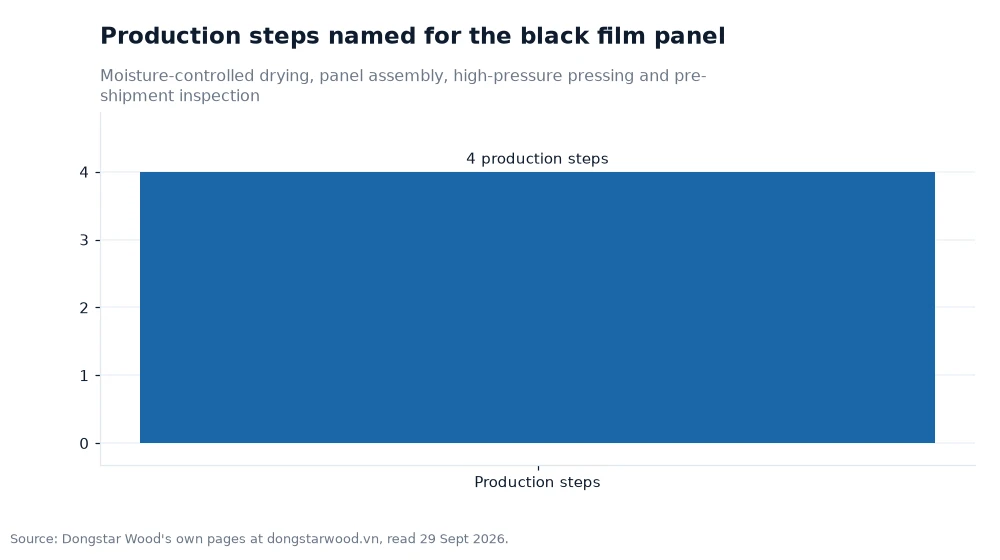
- Four production steps are named, ending with a batch inspection before shipment.
What an acacia core is chosen for
Acacia grows as a plantation species across Vietnam, which makes the veneer supply predictable in a way that imported hardwood is not. The published build for this panel is acacia throughout, and the density it brings is what holds screw and nail fixings without the panel crushing around them.
The commercial logic is the same as the technical one. A panel with a stable, locally grown core can be pressed to a consistent thickness at a cost per project that suits concrete work where the formwork is not expected to outlast the building phase. The build sold as Black Film Faced Plywood pairs that core with a melamine bond, which is where its published cycle count comes from.
Four production steps and what each one removes
The page names the process from drying to dispatch, and each step exists to take a variable out of the finished panel. Reading them in order also shows a buyer where a quality complaint would have to originate if one ever appeared.
| Step | What happens | Variable it removes |
|---|---|---|
| Moisture-controlled drying | Veneer is dried to a controlled moisture level | Blistering and internal stress after pressing |
| Multi-layer panel assembly | Acacia veneer layers are built up crosswise | Warping and splitting under load |
| High-pressure hot pressing | The stack is consolidated with the melamine bond | Delamination during repeated wet and dry cycles |
| Pre-shipment inspection | Batch checks before loading | Thickness drift and core faults reaching the buyer |
The 10 Hours Boiling Test behind the melamine bond
The bond on this panel is melamine, and the published reference point is a boiling-water test of approximately ten hours. That figure is an indicator of adhesion rather than a service promise: it describes how the glue line behaves under sustained heat and moisture, not how many pours a site will get from a panel.
It is still a useful number when two offers look identical on paper. A buyer comparing an ordinary black film panel against a cheaper alternative can ask which bond is used and how it was tested, and a supplier who can name the test has already answered part of the durability question.
Why 21 mm and 1250 × 2500 mm lead European order lists
Two specifications dominate the published account of European demand: 21 mm as the most requested thickness, with 18 mm behind it, and 1250 × 2500 mm as the most requested format. Both make sense on site, where a thicker panel deflects less between props and the larger format covers more wall per fix.
Buyers ordering outside those two defaults should say so early. Sizes run out of 1220 × 2440 mm through 1250 × 2500 mm and 1500 × 3000 mm through to custom panels of up to 1830 × 3830 mm, and a non-standard format is easier to schedule when it is named at the enquiry stage rather than at the order stage.
Worked example: contact area across three cycles
Take the 1250 × 2500 mm format, which holds 3.125 m² of panel a sheet (1.25 m × 2.5 m). At three cycles it delivers 3 × 3.125 = 9.375 m² of concrete contact (example); at the top of its published band, 5 × 3.125 = 15.625 m² (example).
Apply that to a foundation package of 3,000 m² of contact area. At the conservative end the work needs 3,000 ÷ 9.375 = 320 panels (example), and at the optimistic end 3,000 ÷ 15.625 = 192 panels (example). Pricing the programme on the optimistic figure is where most formwork budgets go wrong.
Where the panel is used and who buys it
The published supply note names distributors, builders and formwork companies. That mix explains the specification: a distributor wants a stable format and a consistent core between deliveries, a builder wants panels that are light enough to move by hand, and a formwork company wants a cycle count it can plan a programme around.
Foundations, temporary structures and covered faces are the natural application. Where concrete will be left exposed, a higher-grade panel with a heavier film is the published option; where the schedule leads and the face is hidden, the economical black panel keeps the cost per square metre of contact in a sensible place.
Writing the enquiry so the reply is useful
State four things in the first message: thickness, format, quantity and the surface required. A supplier answering "21 mm, 1250 × 2500 mm, ordinary black film" knows exactly which line to quote and which inspection record applies to the batch.
Then ask for the two inspection items that are actually published for this panel: panel thickness consistency and core construction integrity. Both are named in the production description, so a request for them is a straightforward question rather than an unusual one.
Add the application to that list. A panel going under a foundation slab and a panel facing a visible retaining wall are separated by surface choice rather than by format, so naming the application lets the supplier flag the difference before the order is written.
Ask about edges as well. Sealing practice between pours is what carries a published cycle count onto a real site, and a supplier who recommends a routine is easier to plan with than one who quotes a number and stops there.
Mixed shipments are normal in this part of the range. Distributors routinely combine the economical black panel with higher-grade film faced sheets so that hidden structure and visible walls are both covered by the right product from a single load.
Finally, confirm what happens if a batch arrives outside tolerance. A reply that names the inspection record behind the shipment, and the person who signs it, closes the loop opened by the first enquiry.
Frequently asked questions
How many pours can an economical black film panel take?
Published guidance is roughly 3–5 cycles under normal site conditions, against 10–20 cycles for a high-grade panel. The lower figure is realistic for foundations and temporary works, and it depends on edge care and how gently the panels are stripped.
What is inspected before the panel is shipped?
Two items are named in the production description: panel thickness consistency and core construction integrity. Both are batch checks rather than one-off tests, which is what allows a delivered panel to be compared against the record from the run that produced it.
Which buyers does this panel suit best?
The published supply note names distributors, builders and formwork companies. It suits programmes where the concrete face will be covered or the shuttering is needed for a short run, and where a smooth finish from the film is still wanted on every pour.
Where to look next
Two pages put this panel in context. Anyone weighing a short-cycle build against a longer one should read the full film faced panel range and its higher-grade options, while projects where crews walk on the formwork should check the textured anti-slip alternative before fixing the surface.
Process steps, cycle counts and the boiling-test figure are reported by the factory's own website, as consulted on 29 Sept 2026 as quoted in the table above as quoted in the table above as quoted in this article[1].